
Part 1 of The TIER Files, a series that follows Alberta’s industrial carbon money from the smokestack to wherever it actually ends up.
Everything here comes from audited financial statements and public budget documents. Sources, with page numbers, are at the bottom.
Somewhere in Alberta right now, a facility manager is signing off on a compliance payment and hurtling it into her company’s delegation of authority.
Her plant emits more than 100,000 tonnes of carbon dioxide equivalent a year, which makes it a regulated facility under the Technology Innovation and Emissions Reduction Regulation, the system everyone in the province just calls TIER.
The plant came in over its emissions benchmark this year, so she has a few ways to settle the difference. She can buy credits from facilities that beat their benchmarks. She can buy offsets. Or she can pay into the TIER Fund at the government’s set price, currently $95 a tonne.
Let’s say she pays the fund, because projects are hard, permits are lengthy, etc.
Where does that money go?
If you asked her, she would probably say what most people in Alberta industry would say: it funds emissions reduction. That is the fund’s name, its stated purpose, and the story told in government announcements that draw on it. Grants for carbon capture pilots, methane detection, industrial efficiency, the clean technology showcase that runs across the province’s news releases.
If you’ve been on ERA’s announcement newsletter for any period of time it sounds like everything is working very well, but I wanted to check. So I pulled the TIER Fund’s audited financial statements, published each year inside the annual report of the Ministry of Environment and Protected Areas, and followed the money.
The fund collected $2.64 billion between April 2021 and March 2025. A good amount we all agree.
Of that, $590 million went out as innovation and technology grants.
$1.09 billion went to the General Revenue Fund.
That matters because Alberta’s flagship industrial climate program derives much of its public legitimacy from a simple promise: industry pays, technology gets funded, emissions fall.
But the numbers tell a messier story.
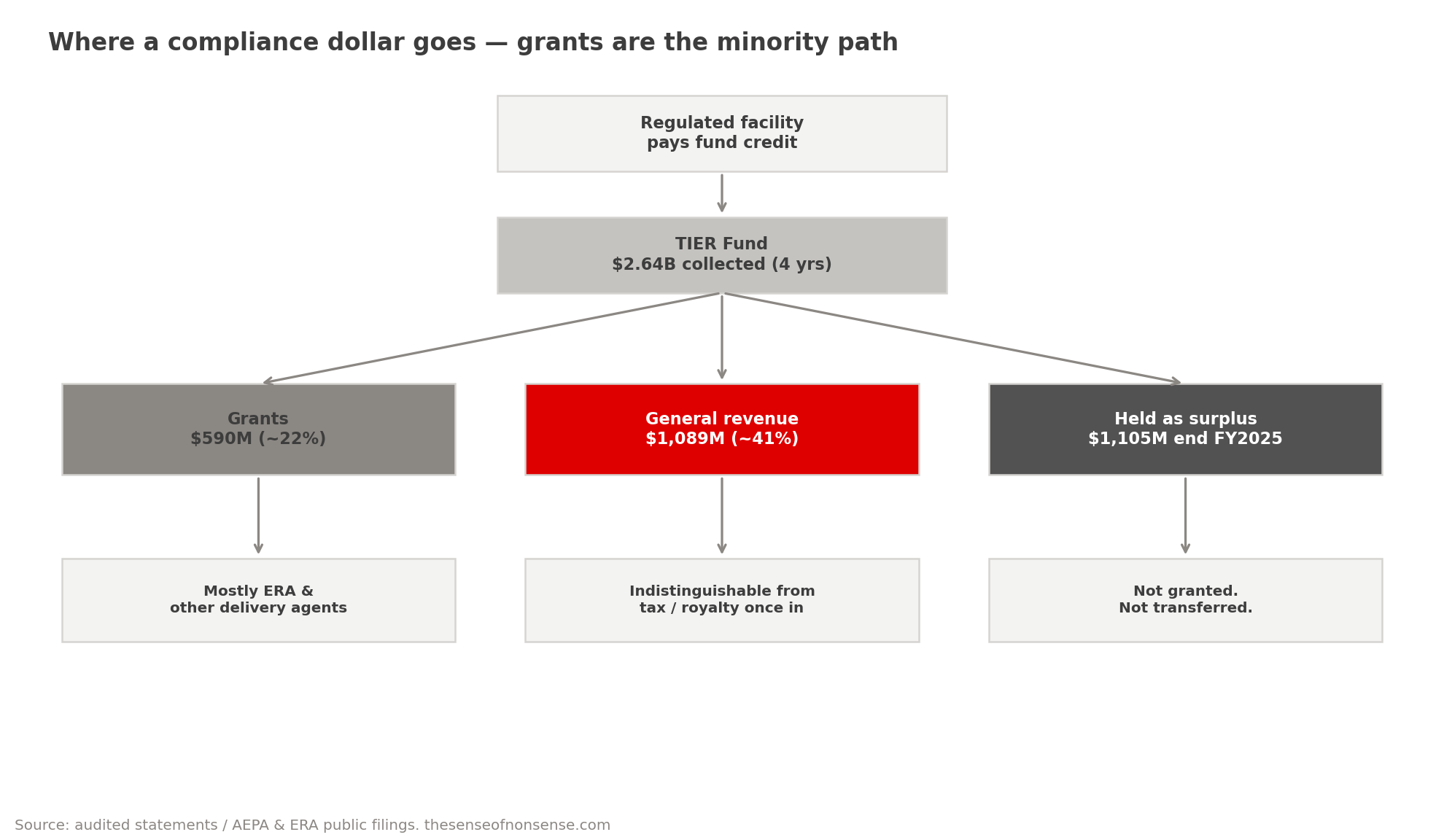
Where a compliance dollar goes, drawn from the Statement of Operations. Surplus is a stock; grants and transfers are four-year flows.
How the fund is supposed to work
A quick primer on the plumbing:
TIER is Alberta’s industrial carbon pricing system. It covers facilities emitting 100,000 tonnes or more per year, plus smaller facilities that opt in. Each facility gets a benchmark. Beat it and you earn credits you can sell. Miss it and you owe, payable in credits, offsets, or cash to the TIER Fund.
The fund is the cash end of that machine. It is a regulated fund administered by Environment and Protected Areas, with its own audited statements.
Money flows in from compliance payments across four sectors: mining and oil and gas, utilities, manufacturing, and transportation.
And it’s worth pausing on who actually writes those cheques, because the sector mix has been quietly telling its own story. In fiscal 2022 the utilities were the biggest payers at $388.6 million, back when coal was still on the grid. By fiscal 2025 the utilities paid $24.7 million, a 94 per cent drop, partly because the ministry’s own reporting says electricity emissions are down 59 per cent since 2005 and the last coal plant converted in 2024 (genuinely good news, credit where due), and partly because everyone discovered the cheap credits we’ll get to shortly. Mining and oil and gas went the other direction for a while, peaking at $454.4 million in fiscal 2024 before collapsing to $97.4 million with everyone else.
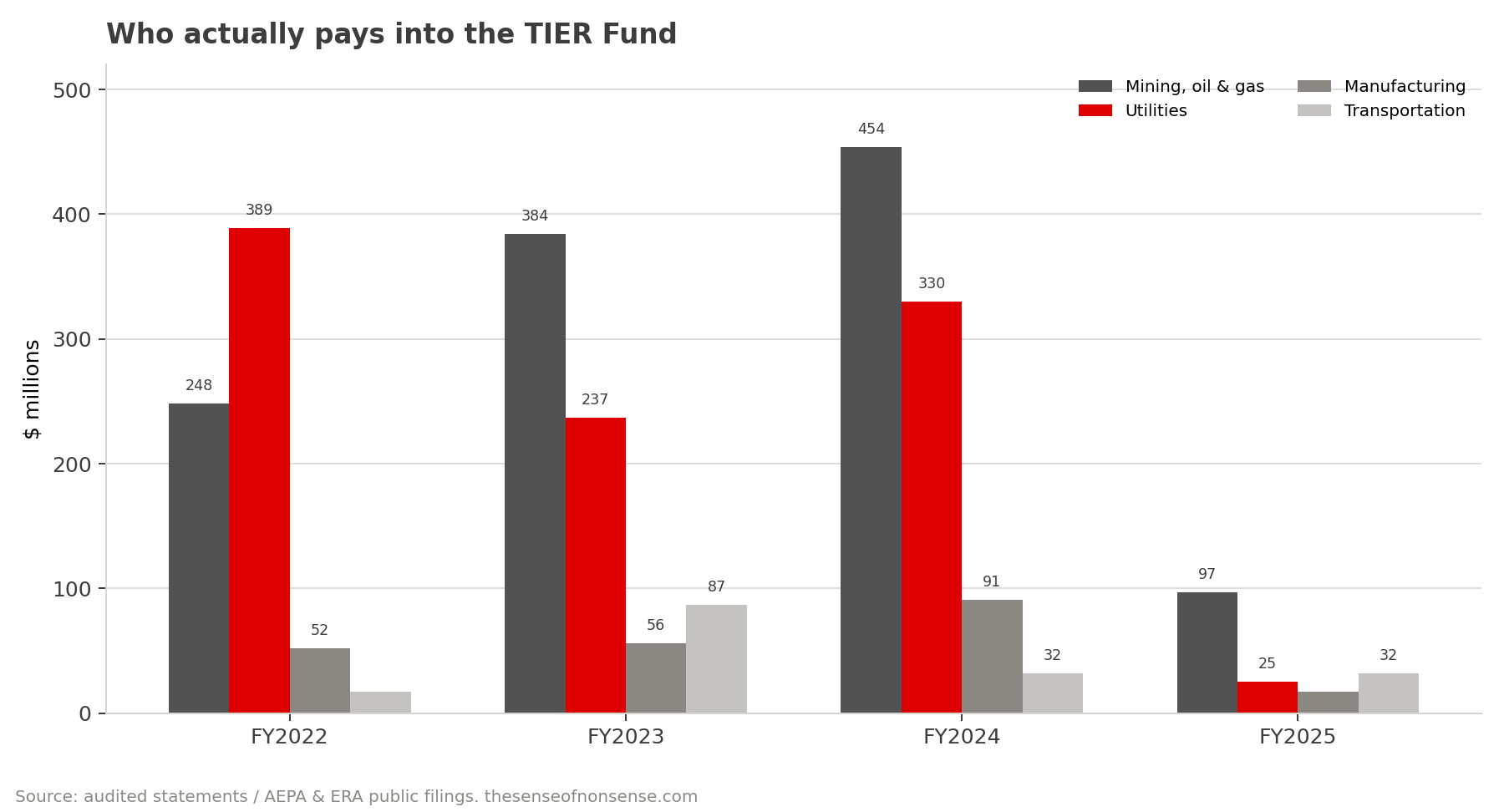
Who pays into the fund, by year. The utilities story is coal leaving the grid plus cheap credits arriving.
Money flows out three ways: a small administration expense, grants for innovation and technology, and a line called Transfers to the General Revenue Fund. The largest grant recipient is Emissions Reduction Alberta (ERA), the arm’s-length agency that runs many of the funding competitions (more on that later). ERA is not the only destination for those grants; Environment and Protected Areas also disburses to other delivery agents, so when this series talks about the grant line it means the whole innovation-and-technology outflow, of which a large share is routed to ERA.
That last line, the transfer to general revenue, is the one that doesn’t seem to be put in a news release.
Four years of audited statements
Here is the fund’s own accounting for fiscal years ended March 31, in thousands of dollars. Every figure below is transcribed from the audited statements.
| FY2022 | FY2023 | FY2024 | FY2025 | |
|---|---|---|---|---|
| Revenue | 709,448 | 772,102 | 936,166 | 223,345 |
| Innovation and technology grants | 205,137 | 181,105 | 94,330 | 109,426 |
| Transfers to General Revenue Fund | 311,949 | 335,451 | 416,666 | 24,699 |
| Accumulated surplus, year end | 336,805 | 591,821 | 1,016,606 | 1,105,432 |
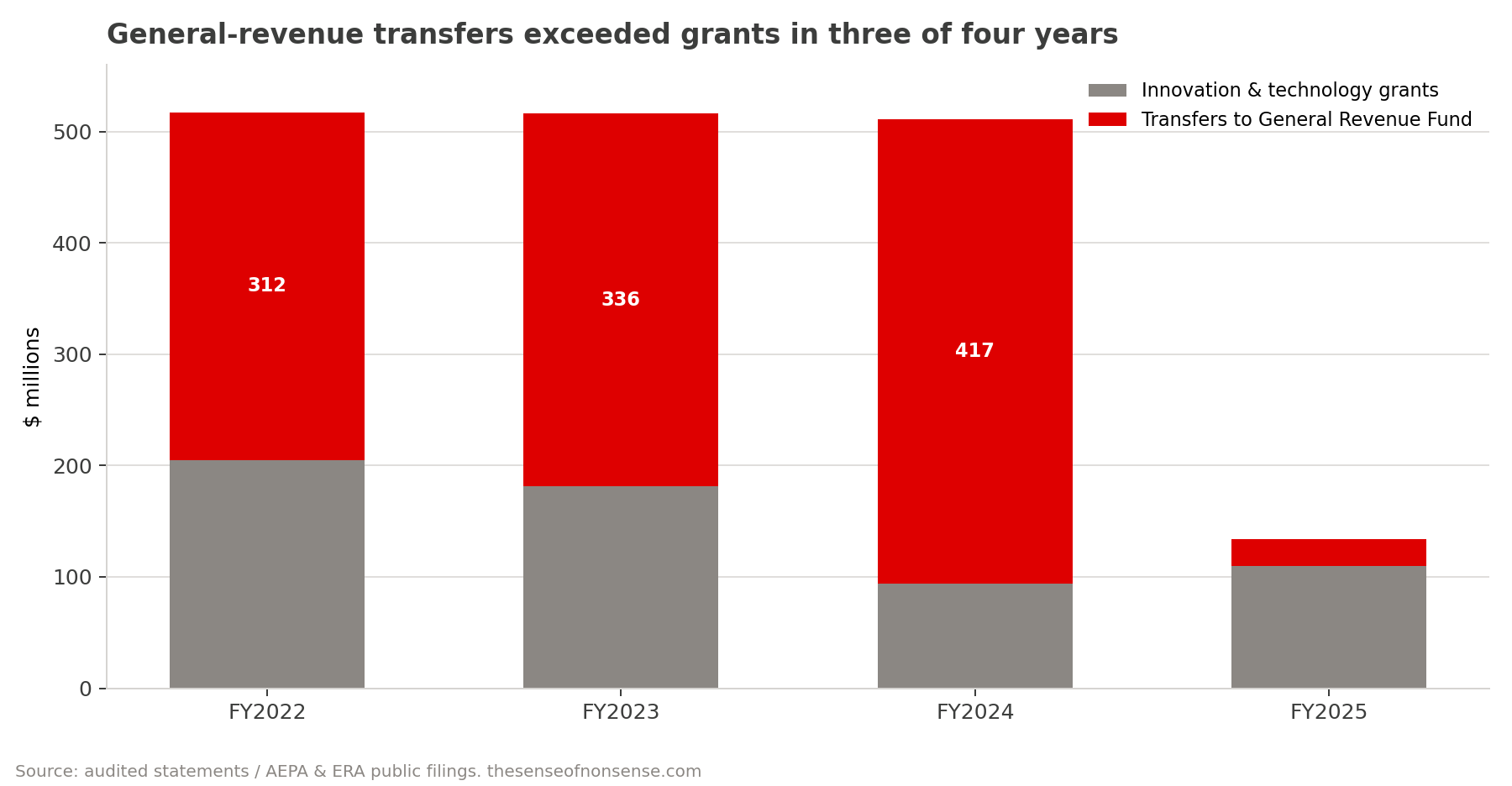
In the first three years, the transfer to general revenue exceeded the emissions reduction grants. In fiscal 2025 the pattern flipped as revenue collapsed.
Read the middle two rows against each other and you see the pattern. In fiscal 2022, 2023, and 2024, the transfer to general revenue exceeded the grants for emissions reduction. In fiscal 2025, grants were $109.4 million and the transfer fell to $24.7 million, because compliance revenue collapsed and there was less cash to move.
Across the four years, the fund still moved $1,088.8 million into general revenue and $590.0 million into the grants that are the fund’s public identity.
For every dollar that went to emissions reduction technology (much of it routed to Emissions Reduction Alberta), about $1.85 went to the government’s general accounts.
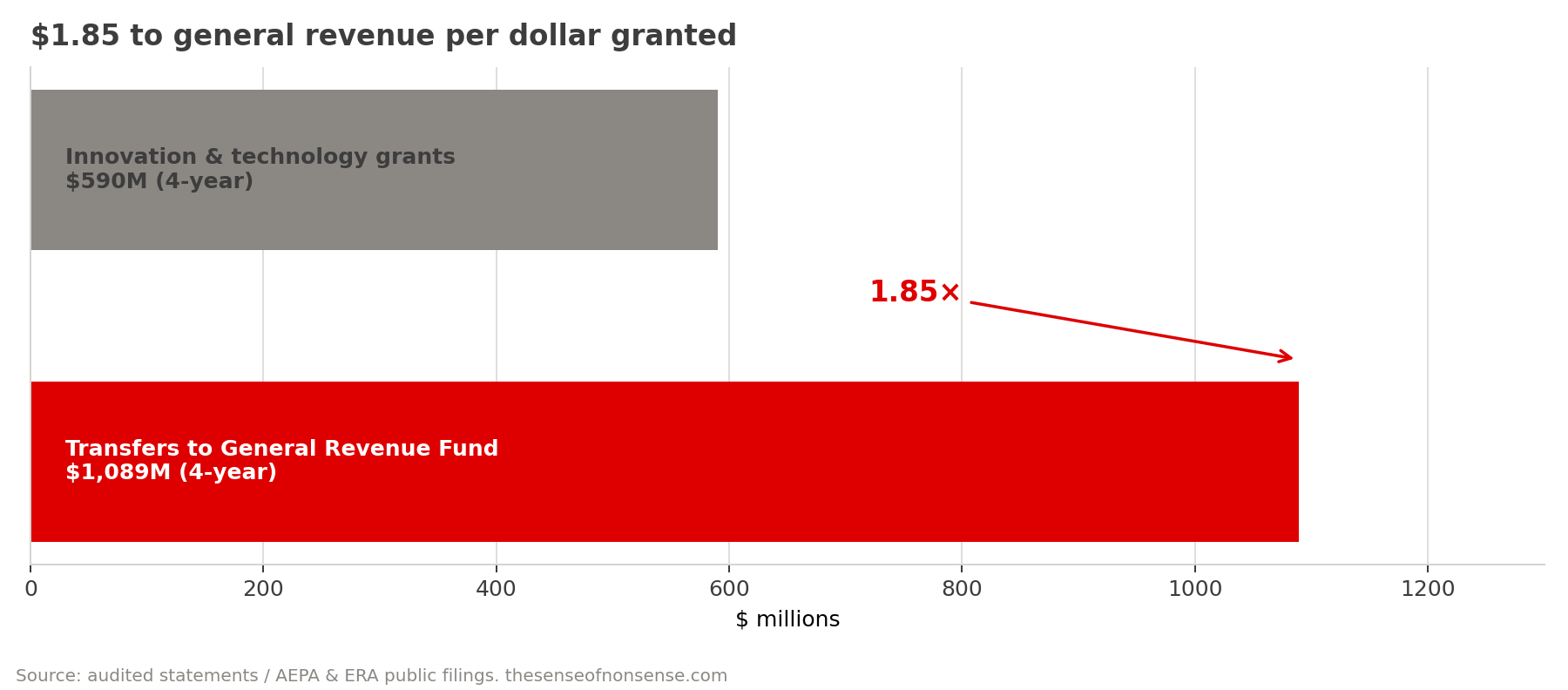
$1.85 to general revenue for every grant dollar. The surplus pile is separate.
The peak year was FY2024. Compliance revenue hit $936 million, the highest in the fund’s history (the TIER Fund itself dates to 2020; predecessor industrial carbon funds are a different ledger).
Grants that year fell to $94 million, the lowest in the four-year window.
The transfer to general revenue was $417 million, four and a half times the grant spending.
And then there is the bottom row.
While all this money moved through, the fund’s accumulated surplus grew from $337 million to $1.105 billion. That is compliance money collected from industry, not granted, not transferred, just held.
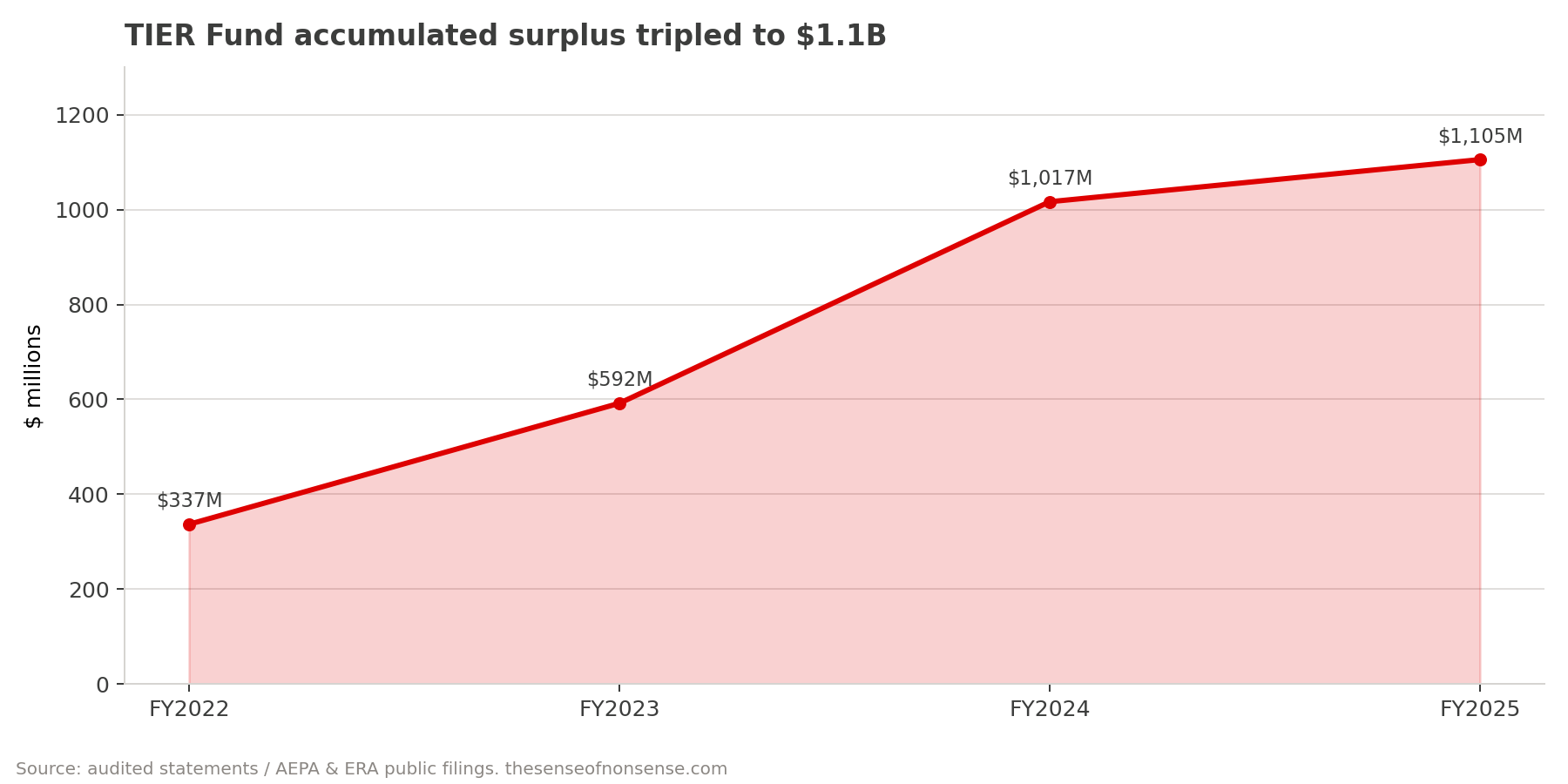
The fund’s accumulated surplus tripled in four years and now exceeds $1.1 billion.
Put another way: of the $2.64 billion collected, only about 22 cents on the dollar left as innovation grants. The rest went to general accounts or stayed in the fund.
What general revenue really means
The honest answer for what general revenue means, from the public record, is that you cannot know.
The government’s position, stated in budget documents over the years, is that TIER dollars support climate-related programming across ministries, delivered through general revenue. Some of that is plausible. The province has funded carbon capture incentives, methane programs, and technology initiatives out of other budget lines.
But the accounting only runs one way.
The TIER Fund’s statements record the transfer out. Nothing on the other side records what the money became.
Once a dollar enters the General Revenue Fund, it is indistinguishable from a dollar of income tax or a dollar of oil royalty, and no published document reconciles $1.09 billion of TIER transfers against $1.09 billion of climate spending elsewhere.
The claim that the money still serves the fund’s purpose is not verifiable from anything the province publishes.
For a system whose legitimacy rests on the promise that industry’s carbon costs are recycled into emissions reduction, that is a remarkable gap.
A standard concession belongs here because it is true: none of this is illegal. It has been rarely noticed outside policy circles, and certainly not addressed. (Pembina and the Canadian Climate Institute have both written on how TIER revenue is used; the ledger arithmetic above is still sitting there for anyone who wants the receipts.)
The legislation gives the government discretion over the fund. The transfers are approved, disclosed in the statements, and audited.
This series isn’t going to be about hidden money. Of course the government’s fiscal opaqueness is interesting, but not my skill set to talk about (complain about, sure).
This series is about what the disclosed numbers say once you actually read them and try to make them make sense.
The year the machine seized
Look again at that FY2025 revenue figure: $223 million, down 76 per cent from the year before.
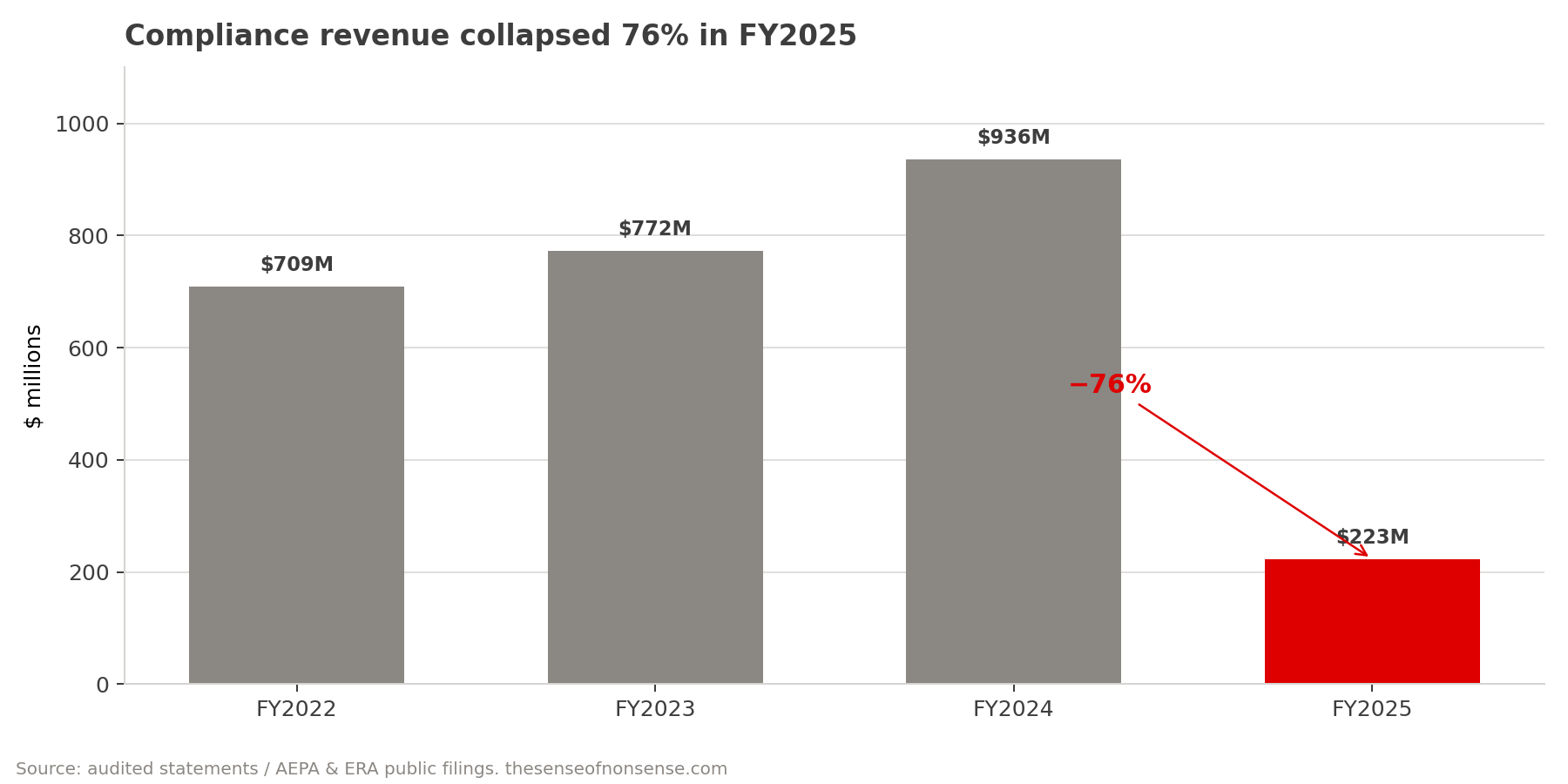
Compliance revenue collapsed in FY2025 as facilities switched to discounted credits.
The fund’s own notes explain the why of it.
Facilities can meet their obligations with credits instead of cash, and by 2024 the credit market was drowning in supply and it, of course, is supposed to be a rational market.
Credits were trading at a steep discount to the $95 fund price, so as any good compliance manager would do, the facilities rationally bought cheap credits instead of paying the fund.
The statements model the uncertainty with an honesty that borders on alarming: depending on how many credits facilities used, annual revenue could land anywhere between $306 million and $2.35 billion.
So the province froze the fund price at $95 by ministerial order on May 5, 2025 (Ministerial Order 13/2025), and the statements say the financial effect on future years cannot reasonably be estimated (better than saying it lands somewhere in a range of $2 billion).
And here is the part that makes the collapse feel less like weather and more like a forecasting problem: the government’s own budget column sits right there in the audited statements beside the actuals, which is a bold formatting choice, because for fiscal 2025 the plan was $539 million of revenue and $295 million of grants. What arrived was $223 million of revenue, and what went out was $109 million of grants. The fund missed its own revenue plan by 59 per cent and delivered 37 per cent of its own granting plan, in the same year, in the same table.
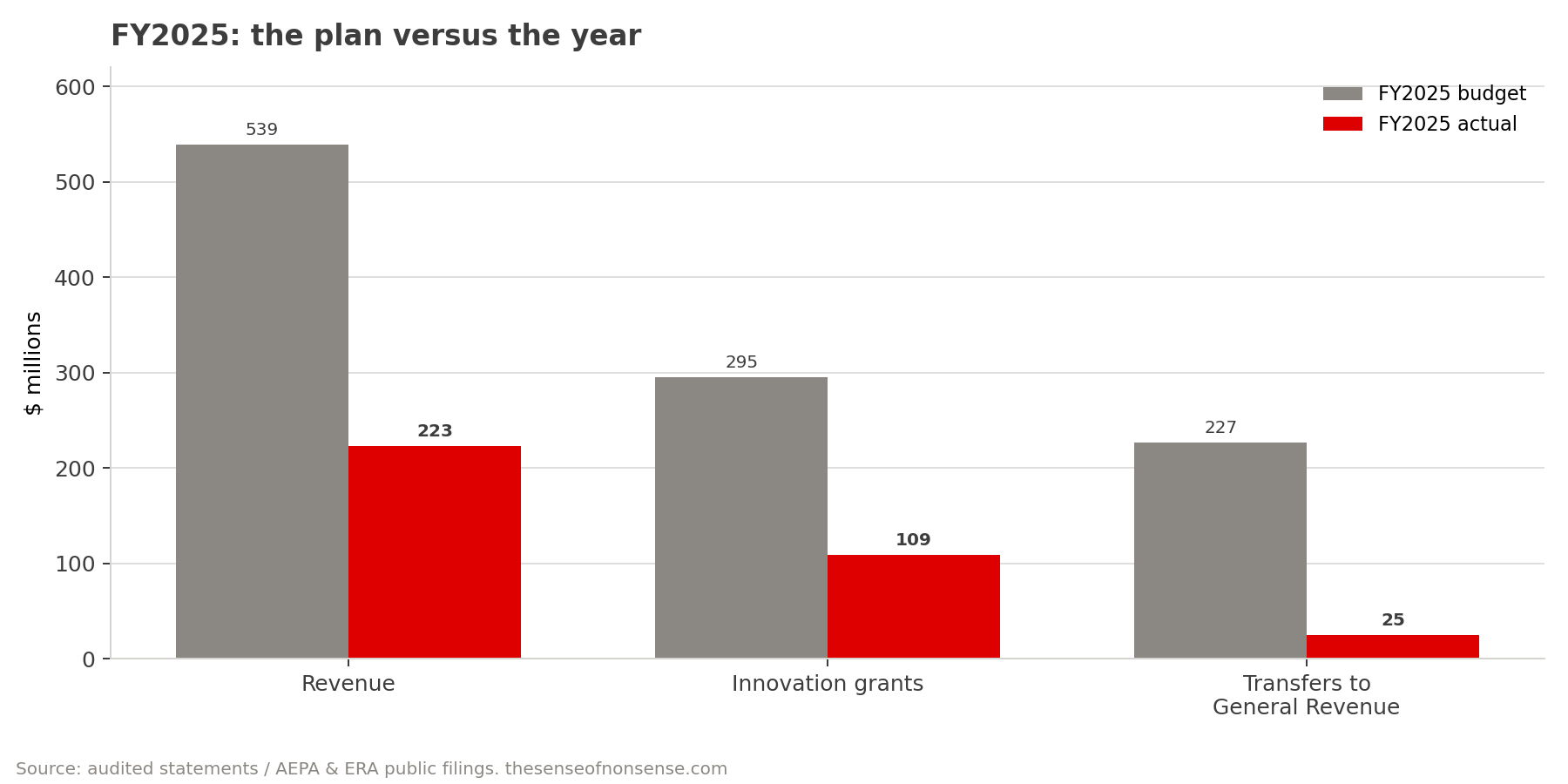
The plan versus the year, from the same audited table.
In other words, the revenue engine of Alberta’s flagship climate program is now hostage to a glutted credit market, and the people who run it have told the auditors they cannot predict what it will produce.
Let’s hold onto that thought. It becomes important later in this series, when the focus turns to the regulator responsible for that credit market and to what Alberta actually spends running it.
Why this is Part 1
The detour to general revenue is the frame for everything that follows because it establishes the central pattern of the TIER system: it is the gap between the story and the ledger.
The story is, or was, a virtuous circle. Industry pays, technology gets funded, and emissions fall.
The ledger shows a fund that retained more than a billion dollars, transferred more than a billion more to general purposes, and granted out only a fraction of what it collected in its strongest four-year run.
And the grants themselves, the $590 million that did flow toward emissions reduction?
Most of that went to a single arm’s-length agency with its own bank accounts, its own board, and its own fifteen-year paper trail.
What that agency does with the money, how much of it sits in guaranteed investment certificates, how much funded work gets cancelled after the announcement, and where the environmental credit for those projects ultimately lands, each of those is a story.
The documents for this are all public.
Nobody is hiding them (transparency!), and as far as I can tell, almost nobody reads them.
Next: the eight-million-dollar regulator.
If I have misread a line item, the documents are linked below; show me and I will correct it.
Sources
Everything in this essay comes from audited financial statements and public budget documents. Key references:
- Technology Innovation and Emissions Reduction Fund, audited financial statements. Published in Environment and Protected Areas Annual Report 2024-2025, pp. 52-74 (FY2025 and FY2024 figures, including sector-level revenue; Statement of Operations and budget column p. 56; revenue uncertainty / Monte Carlo note p. 63; fund price freeze, Note 8, p. 72). open.alberta.ca
- TIER Fund audited financial statements, Environment and Protected Areas Annual Report 2023-2024, p. 56 (FY2024 and FY2023 figures, including sector-level revenue). open.alberta.ca
- TIER Fund audited financial statements, Environment and Protected Areas Annual Report 2022-2023, p. 56 (FY2023 and FY2022 figures, including sector-level revenue). open.alberta.ca
- Environment and Protected Areas Annual Report 2024-2025, Results Analysis, objective 2.2, p. 35 (electricity emissions down 59 per cent since 2005; the grid’s full transition off coal in 2024).
- Technology Innovation and Emissions Reduction Regulation overview (system mechanics, compliance options, 100,000-tonne threshold, opt-in), alberta.ca.
- Ministerial Order 13/2025, May 5, 2025 (fund price maintained at $95 per tonne), as disclosed in Note 8 of the FY2025 TIER Fund statements.
- Emissions Management and Climate Resilience Act, RSA 2003, c. E-7.8 (the statutory basis for the fund and the government’s discretion over its use). kings-printer.alberta.ca
- On ERA as a major (not sole) grant destination: Emissions Reduction Alberta audited financial statements and annual reports, eralberta.ca; TIER Fund Statement of Operations grant line as transcribed above.
- Policy-circle coverage of TIER revenue use (context for the “rarely noticed” line, not a source for the dollar figures): Pembina Institute and Canadian Climate Institute publications on Alberta industrial carbon pricing and revenue recycling.